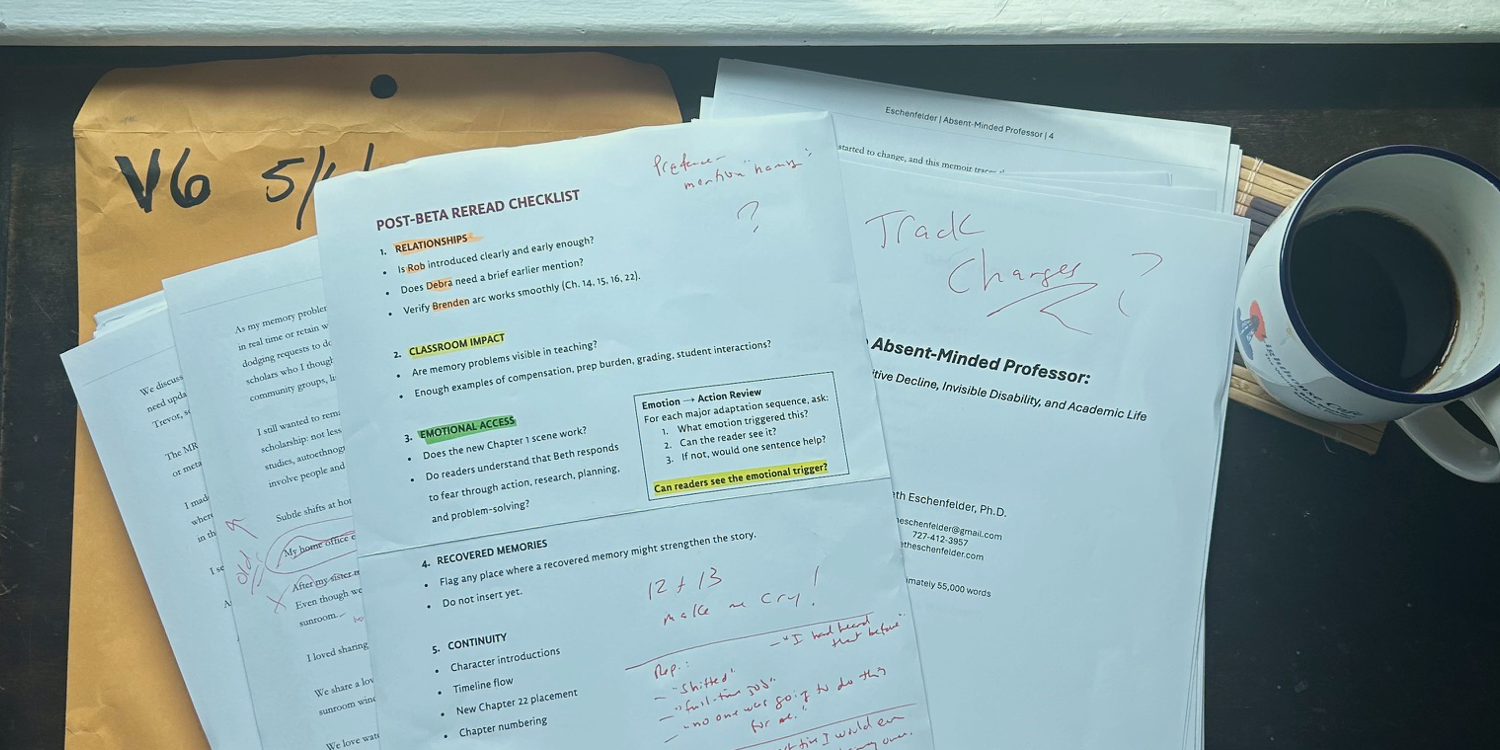
Done. I can’t believe I finally have a first draft of my memoir.
I’m still stunned that I was able to do this—to write a memoir. As in, how could someone living with and struggling with cognitive impairment pull this off?
A year ago, I was struggling and doubted whether I could manage this task.
But after years of thinking about sharing my story, I was determined to see it through.
What now?
Is it good enough to publish? How do I get to that point?
I realized I was entering a territory I was not yet familiar with. This certainly is different from publishing articles in academic journals. This has a whole different culture and protocols to learn.
I reached out: to friends who are published authors, to my many how-to books, online writing forums, and to AI.
Beta reviewers? What are beta reviewers?
Things I needed to learn, and I did.
Selecting my reviewers, I had to consider balanced viewpoints, what advice and feedback I needed from them, and how to ask them to take on such a substantial task.
And I proceeded.
And THANK YOU to all of them. They made a world of difference in my work.
I already knew there would be a lot of proofreading, editing, adding, and deleting, and the feedback from beta reviewers made those steps even more substantial.
And then I encountered a whole other level of cognitive challenge.
My god, what did I write?
Did I include that one thing? What about the other? And where the heck is it?
As I discussed in one of my previous Field Notes, A Hallelujah Moment, I discovered ways AI could provide the scaffolding I needed to help me hold things together throughout my writing process. Now I was discovering I needed some of those same supports simply to navigate the book I’d written.
Even after working through the manuscript numerous times, I still struggled to hold it all in my head. I still needed help recalling what I wrote and where to find it.
“My Chat, can you help me update my mini-chapter summaries?… think memory nuggets; key words or phrases that will help recall what I wrote in each chapter.”
I then worked through all the chapters and extra parts to develop short phrases that would help me recall the chapter content: Four-Four, Sanibel breakfast, tarot reading, file boxes, feeding the cats… Anything that would make it stick.
I’m realizing I still need adaptations and accommodations to help me through this process—all stages of it.
Finishing the manuscript does not mean I overcame the cognitive impairment that made writing it difficult.
I found ways to write a memoir with cognitive impairment. Now I need to find ways to keep working with one.
And apparently, there is still a lot of work ahead.